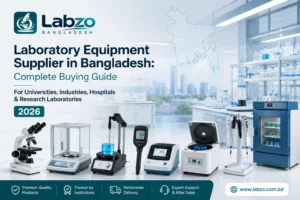
Whether you are establishing a new laboratory, upgrading an existing facility, expanding a research center, or purchasing scientific instruments for routine quality control, one decision will have a long-term impact on your laboratory’s performance: choosing the right laboratory equipment supplier.
In Bangladesh, laboratories play a critical role across education, healthcare, pharmaceuticals, food safety, textiles, agriculture, fisheries, environmental monitoring, water quality testing, manufacturing, and scientific research. The accuracy of laboratory results depends not only on the skills of laboratory professionals but also on the quality, reliability, calibration, and ongoing support of the instruments they use.
A laboratory instrument is not simply another piece of equipment. It is an investment in data quality, operational efficiency, regulatory compliance, and research outcomes. Selecting equipment solely because it has the lowest price often leads to higher long-term costs through inaccurate measurements, frequent repairs, limited technical support, or difficulty obtaining spare parts.
That is why selecting a laboratory equipment supplier should never be based on price alone. A professional supplier should be able to provide technical consultation before purchase, help you select suitable instruments for your application, assist with installation and commissioning, offer user training where required, and continue supporting your laboratory throughout the product lifecycle.
Bangladesh has experienced significant growth in scientific, industrial, and research activities over the past decade. Universities are expanding research programs, pharmaceutical manufacturers continue to invest in quality assurance laboratories, food processing industries require stricter quality control, textile manufacturers increasingly rely on analytical testing, and government agencies are strengthening environmental and water quality monitoring.
As a result, demand has increased for reliable laboratory instruments such as:
However, purchasing the correct instrument is only one part of the process. Laboratories also need dependable suppliers who understand technical specifications, application requirements, calibration practices, maintenance schedules, and after-sales service.
Many companies can sell laboratory instruments. Far fewer can act as long-term technical partners.
A professional laboratory equipment supplier typically provides:
These services reduce operational risks and help laboratories achieve more reliable results over time.
This guide has been prepared for professionals involved in laboratory planning, procurement, testing, quality assurance, education, and research across Bangladesh.
It is especially relevant for:
Departments of chemistry, biology, physics, microbiology, biotechnology, environmental science, engineering, and agricultural science require dependable laboratory equipment to support teaching and research activities.
Clinical laboratories rely on accurate instruments to support diagnostic workflows, quality assurance, and patient care.
Manufacturing and quality control laboratories require instruments that support compliance, repeatability, and reliable analytical performance.
Food laboratories use scientific equipment to monitor product quality, raw materials, microbiological safety, and regulatory compliance.
Textile laboratories perform color measurement, water analysis, chemical testing, and quality verification during manufacturing.
Water quality management depends on regular monitoring of parameters such as pH, dissolved oxygen, conductivity, ammonia, and temperature.
Government agencies, consulting firms, and environmental researchers require instruments for water, wastewater, soil, and environmental analysis.
Instead of simply listing laboratory products, this guide explains how to make informed purchasing decisions.
In the following sections, you will learn:
By the end of this guide, you should have a clearer understanding of how to select laboratory equipment that fits your technical requirements, budget, and long-term operational needs.
Over the past two decades, Bangladesh has experienced remarkable industrial, educational, and scientific development. Alongside this growth, laboratories have become essential to maintaining quality standards, ensuring regulatory compliance, supporting research, and improving public health.
Today, laboratory facilities are no longer limited to universities or government research institutes. Modern laboratories operate across almost every major sector of the country’s economy, creating continuous demand for reliable laboratory and scientific equipment.
Whether testing pharmaceutical products, monitoring drinking water quality, verifying textile dye consistency, analyzing food safety, conducting environmental assessments, or supporting academic research, laboratories rely on accurate instruments to produce dependable results.
As laboratory applications continue to expand, organizations are increasingly looking beyond simply purchasing equipment. They seek suppliers who can provide technical guidance, application support, installation assistance, and dependable after-sales service.
Several long-term factors are driving the growth of Bangladesh’s laboratory sector.
Universities across Bangladesh continue to establish new laboratories for undergraduate education, postgraduate research, and scientific innovation. Departments such as chemistry, biology, microbiology, biotechnology, environmental science, pharmacy, agriculture, engineering, and materials science require modern laboratory equipment to support practical learning and research activities.
Research projects funded by government agencies, international organizations, and universities also increase demand for analytical instruments, laboratory consumables, and precision measuring devices.
Bangladesh has developed one of the largest pharmaceutical manufacturing sectors in the region.
Every pharmaceutical manufacturer depends on laboratory testing throughout production, including:
These activities require accurate analytical instruments, laboratory balances, incubators, spectrophotometers, pH meters, and many other specialized laboratory devices.
Consumers and regulatory authorities increasingly expect safe, high-quality food products.
Food laboratories perform tests to evaluate:
As food manufacturing grows, investment in laboratory equipment continues to increase.
Bangladesh is internationally recognized for its textile and garment industry.
Modern textile laboratories perform various analyses including:
Reliable laboratory instruments help manufacturers maintain product quality while meeting customer requirements and environmental standards.
Environmental laboratories play an increasingly important role in protecting natural resources.
Routine testing may include:
These applications require dependable water quality instruments, analytical equipment, and laboratory accessories.
Bangladesh’s fisheries and aquaculture sector relies heavily on water quality management.
Routine monitoring of parameters such as pH, dissolved oxygen, temperature, conductivity, alkalinity, hardness, ammonia, and other water quality indicators helps improve fish health and production efficiency.
As commercial aquaculture expands, demand for portable and field-ready testing equipment is expected to continue growing.
Laboratory equipment supports a wide variety of industries and institutions across Bangladesh.
| Sector | Common Laboratory Applications |
|---|---|
| Universities | Teaching laboratories, research, student practical work |
| Hospitals | Clinical laboratory testing |
| Diagnostic Centers | Sample analysis and quality control |
| Pharmaceutical Companies | Quality assurance, research and development |
| Food & Beverage | Product quality and safety testing |
| Textile & Garments | Dye testing, chemical analysis, water quality |
| Fisheries | Water quality monitoring |
| Agriculture | Soil, fertilizer, and water analysis |
| Environmental Organizations | Water, wastewater, and environmental testing |
| Government Laboratories | Regulatory testing, public health, research |
Each sector has different technical requirements, which means selecting the right laboratory equipment involves understanding the intended application rather than choosing equipment based on price alone.
Many organizations encounter similar difficulties during the procurement process.
Some of the most common challenges include:
Lower-cost instruments may appear attractive initially but can lead to higher maintenance costs, inconsistent performance, or limited technical support over time.
Different applications require different levels of accuracy, durability, and functionality. An instrument suitable for classroom teaching may not be appropriate for pharmaceutical quality control or research.
Without expert consultation, buyers may purchase equipment that does not fully meet their laboratory’s requirements.
Installation, troubleshooting, maintenance, and calibration support are essential for many laboratory instruments. Lack of post-purchase support can significantly affect laboratory productivity.
Long equipment downtime often results from limited access to replacement parts or qualified technical service.
The expectations placed on laboratory suppliers have changed considerably.
Organizations today increasingly look for suppliers who can support the entire lifecycle of laboratory equipment rather than simply delivering products.
A modern laboratory equipment supplier should ideally provide:
This approach helps laboratories reduce operational risks and maximize the value of their investment.
Bangladesh’s laboratory ecosystem is expected to continue evolving as industries modernize, research activities expand, and quality standards become more stringent.
For laboratory managers, researchers, procurement teams, and industrial organizations, choosing a supplier should therefore be viewed as a long-term partnership rather than a one-time purchase.
The next section of this guide explains what laboratory equipment actually includes, how different categories of scientific instruments are classified, and how to identify the right equipment for your specific laboratory application.
Laboratory equipment refers to the instruments, devices, tools, glassware, safety accessories, and analytical systems used to perform scientific experiments, measurements, quality control, research, testing, calibration, and sample preparation.
Although the term “laboratory equipment” is often associated with universities or research institutions, modern laboratories operate across many industries including pharmaceuticals, healthcare, food processing, textiles, agriculture, fisheries, environmental monitoring, manufacturing, and government regulatory agencies.
Each laboratory has different objectives, but they all depend on one common principle:
Reliable laboratory equipment produces reliable scientific data.
Without accurate instruments, even highly trained laboratory professionals may obtain inconsistent or misleading results.
For this reason, selecting laboratory equipment should always be based on the intended application, required accuracy, regulatory requirements, and long-term operational needs rather than price alone.
Every scientific decision begins with data.
If the data is inaccurate, every decision made afterward may also be inaccurate.
Laboratory equipment helps organizations:
For example:
Although the applications differ, the objective remains the same: obtaining dependable and repeatable results.
One of the most common mistakes made by buyers is assuming that all laboratory equipment serves the same purpose.
In reality, laboratory equipment can be grouped into several functional categories. Understanding these categories makes it much easier to identify the right instrument for a specific application.
Analytical instruments are used to measure, identify, and evaluate the physical or chemical characteristics of samples.
Typical applications include:
Common examples include:
These instruments provide quantitative data that supports scientific decision-making.
Measuring instruments determine specific physical or chemical parameters with a defined level of accuracy.
Typical measurements include:
Measurement accuracy is especially important in regulated industries such as pharmaceuticals, food manufacturing, and environmental testing.
Before many laboratory tests can be performed, samples must be prepared correctly.
Sample preparation equipment helps ensure that testing conditions are consistent and reproducible.
Examples include:
Proper sample preparation improves the reliability of analytical results.
Many laboratory procedures require controlled heating, drying, incubation, or sterilization.
Common equipment includes:
These instruments are widely used in research, microbiology, pharmaceuticals, food laboratories, and industrial quality control.
Maintaining sterile laboratory conditions is essential in microbiology, healthcare, biotechnology, and pharmaceutical laboratories.
The most widely used sterilization equipment includes:
Effective sterilization helps prevent contamination and protects the integrity of laboratory results.
Accurate weighing is fundamental to almost every laboratory workflow.
Examples include:
Even small measurement errors can significantly affect experimental results, making calibration and proper handling essential.
Microscopes allow scientists to observe structures that cannot be seen with the naked eye.
Common types include:
These instruments support education, healthcare, microbiology, materials science, and industrial inspection.
Glassware remains one of the most frequently used laboratory resources.
Common items include:
The choice of glassware depends on the required precision, chemical compatibility, and intended laboratory procedure.
In addition to instruments, laboratories depend on consumables and chemicals for routine operations.
Examples include:
Although these items are often lower in cost than instruments, they are essential for maintaining consistent laboratory performance.
Safety is an integral part of every laboratory.
Common safety equipment includes:
A well-equipped laboratory protects both personnel and the integrity of scientific work.
A common misconception is that one instrument is suitable for every laboratory.
In reality, equipment selection should begin with the intended application.
| Laboratory Type | Typical Equipment |
|---|---|
| University Laboratory | Glassware, microscopes, balances, hot plates, teaching instruments |
| Pharmaceutical QC Lab | Analytical balances, spectrophotometers, incubators, pH meters |
| Food Testing Laboratory | pH meters, moisture analyzers, incubators, analytical instruments |
| Fish Farm Laboratory | DO meters, pH meters, EC meters, ammonia testing equipment |
| Environmental Laboratory | Multiparameter meters, turbidity meters, spectrophotometers |
| Textile Laboratory | Color measurement instruments, pH meters, conductivity meters |
This application-based approach helps organizations avoid unnecessary purchases while ensuring that laboratory capabilities match operational requirements.
A modern laboratory does not rely on a single instrument. Instead, it operates as an integrated system where different categories of equipment work together.
For example, a water quality laboratory may use:
When these components are selected correctly and maintained properly, they support consistent, repeatable, and defensible laboratory results.